


Taking LUMS Research to the Classrooms of Interior Sindh

Researchers at LUMS are tackling problems that range from the links between water, food and energy, to keeping power grids running through blackouts, to using machine learning to predict when a battery will start to lose capacity. In early November, this work did not stay on campus. It travelled to classrooms across Interior Sindh, carried by the National Outreach Programme (NOP) team.
NOP exists so that capable students are not kept out of university by cost: it covers the full cost of a LUMS undergraduate degree for those whose families cannot pay for it. To reach them, two NOP teams worked in parallel between 2 and 7 November 2026, visiting eleven cities and towns and meeting around 3,670 students at 28 schools and colleges. In five of these cities, students heard about LUMS research in their own classrooms, while in several other towns, students met the NOP team for the first time.
Key Highlights
Several sessions opened with a briefing on the Syed Babar Ali School of Science and Engineering (SBASSE), founded in 2008 as Pakistan's first private research school in science and engineering. The message was that students do not need to wait until university to take part in research. Through Research Internships in Science and Engineering (RISE), a school or college student can spend three to four weeks in a research group under a faculty mentor, and the LUMS Science Symposium brought more than 500 high school students to campus in August 2025. The team also ran sessions with younger school students as well as college students, giving them a chance to think about higher education well before they apply.
Having shown what is possible at LUMS, the NOP team explained how NOP makes studying there possible, starting with the Summer Coaching Session (SCS), through which selected students receive mentorship as they prepare for university. Students heard that SCS 2027 is open to those who scored 80% or above in Matric (or have matching O Level grades), are in the first year of Intermediate or A Levels, and can show financial need. They also learned about financial assistance, and the team trained student counsellors to help students fill in the form.
The route took the team through towns it knew and towns it did not. In several places NOP had worked before: 450 students attended sessions at four institutions in Hyderabad, 370 came to the government boys' and girls' colleges in Umerkot, and Sanghar and Mirpurkhas followed with 270 and 260 students. Thatta was the first exception. It was the programme's first visit to the town, and 340 students attended across three institutions.
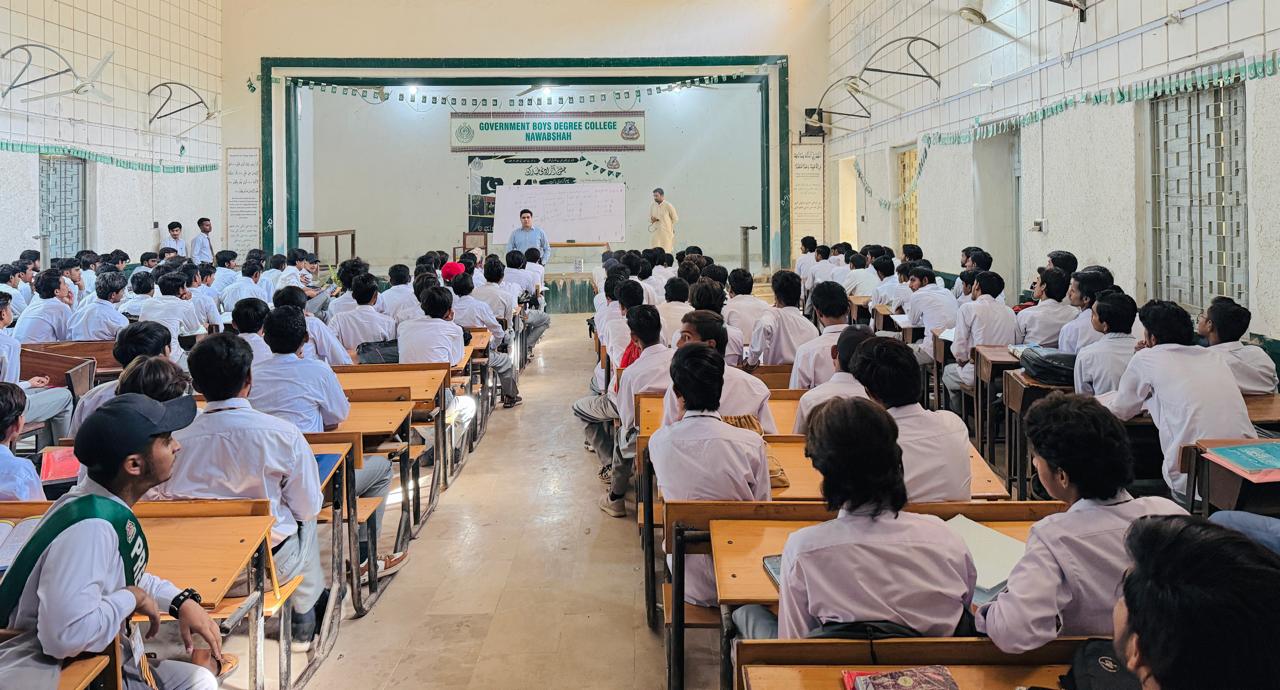
The largest turnouts came from Nawabshah and Sakrand. Nawabshah drew the most students of any city, with 660 attending sessions at the boys' and girls' Government Degree Colleges and at Sachal Sarmast College. Sakrand, which NOP had never visited before, was close behind with 630. In Badin, 460 of the 495 students were at two girls' colleges, and the programme's first visits to Tando Adam Khan and Tando Soomro reached 195 students. Across the whole visit, nearly 45% of the students came from girls' schools and colleges.
The visit also engaged more than a thousand students from the Hindu community across Interior Sindh, reflecting the inclusion at the heart of NOP, which is open to talented students from across Pakistan.
That ethos was echoed by the principal of Government Marvi Girls College in Badin, who said that talent is spread equally among students everywhere, and that the difference lies in motivation, which sessions like these can provide. For students who have never been to Lahore, a photograph of the LUMS campus or a conversation with someone from NOP can turn an unfamiliar university into a place they can imagine themselves in, and give them the sense that they belong there as much as anyone else.
Beyond the classroom, the team also spent time with school leaders and the wider public. A panel discussion in Hyderabad brought NOP together with principals and coordinators of leading schools and representatives of universities in Sindh. On 7 November, an NOP stall at an education expo in Tando Muhammad Khan put the programme before a sizeable crowd of more than 4,000 visitors, many of them from nearby towns.
Impact
With these visits, Thatta, Sakrand, Tando Adam Khan and Tando Soomro have joined the list of towns where NOP has a presence, extending the programme's footprint further across Interior Sindh. The new and renewed connections with principals and teachers matter as much as the numbers: students in these schools and colleges will now have people nearby who know about the programme and can point them towards it. Across the region, more students now know what LUMS offers, from research opportunities to a degree that NOP can pay for in full.
Upcoming Events
Recent News


Ask NOP
Ask NOP
Postal Address
NOP Centre, LUMS
Lahore University of Management Sciences (LUMS)
Sector U, DHA, Lahore Cantt. 54792, Pakistan
Contact Information
Phone: +92-42-3560-8000, Ext: 2179
Email: helpdesknop@lums.edu.pk
Website: https://nop.lums.edu.pk
Web Chat
November - April
Office Hours
Monday to Friday: 8:30 AM – 5:00 PM
Quick Links